Source every claim. Earn every AI citation.
We help YMYL publishers trace every claim to its primary source and surface stronger citations when better ones exist — because AI answer engines cite the pages with the strongest sources.
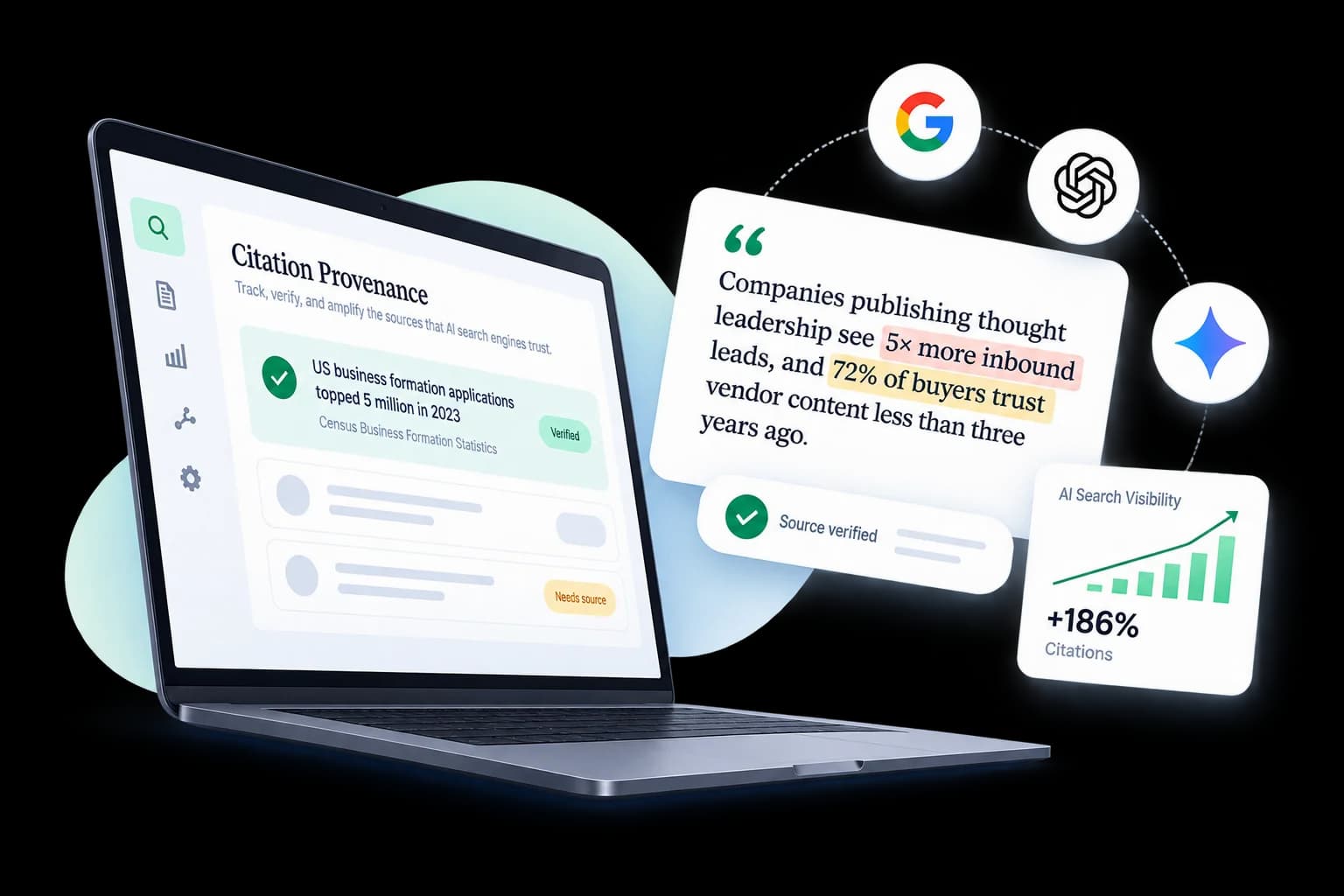
in AI answers
GEO Research
Aggarwal et al., 2024
arXiv:2311.09735
Pages with cited statistics appear in AI answers at rates 40% higher than pages without them. The source matters as much as the claim.
AI answer engines have changed how content gets discovered and credited. They don't rank pages — they cite specific claims. A claim with a traceable primary source gets credited. One with a broken trail gets skipped, regardless of how authoritative your domain looks.
For health, finance, and legal publishers, accuracy was always required. Now it also determines whether AI engines surface your content — or a competitor's. The same work that protects your readers earns you the citation.
A statistic travels. It moves from a study to a press release to a news article to your draft. By the time it reaches you, the original source may be gone, paywalled, or never existed.
Most statistics in health and finance content can't be traced to the study that produced them. They look sourced. They aren't. AI engines figure this out. Your readers eventually do too.
We follow each citation in sequence until it reaches a primary document or runs out. PubMed for clinical figures. The SEC or FCA for financial data. A regulator for economic statistics.
You get a plain verdict — primary, secondary, or broken — plus the document itself, so you know exactly what to cite and how to write the claim so it earns attribution.
Two things, done together.
Tracing a statistic and making it citable are the same work.
Every claim, traced.
We follow each citation in sequence until it reaches a primary document or runs out. One verdict per claim — primary, secondary, or broken — plus the document a reviewer can read.
How provenance worksThe right source, named.
When a stronger primary source exists, we name it. We also suggest how to write the claim so it can be quoted and attributed — the shape AI engines cite, not just the one search engines rank.
How citability worksEvery statistic in your content, checked.
Primary source traced. Verdict delivered. Citation ready — before the draft reaches your reviewers.
Request accessWho this is for
Questions
Every factual claim in a piece of content: whether the citation behind it leads to a document that states the claim, and which source would be stronger to cite. One verdict per claim, plus the document itself.
A model answers from memory and will produce a confident citation that does not exist. We retrieve the actual document, then check the claim against it. If we cannot get the document, we say so instead of guessing.
Pages with verifiable, cited statistics are significantly more likely to appear in AI-generated answers. We make sure your citations hold up so you earn those mentions instead of losing them to a source that does.